Network effect.
Image via Wikimedia CommonsI sell on eBay. Mostly LEGO brand sets, because that's what I have a lot of and what I know a fair bit about (plus b... IBM doesn't sell a lot of LEGO products so I'm clear on Conflict Of Interest concerns)
(I think I've got a link to my store over there on the sidebar... but hey, just in case you missed it, my store is Milton Train Works...)
I made Power Seller status a while back. Nothing big, it's very small time, but we do sell a fair bit. I do OK, but I am there not because it's cheap but rather, it's the biggest venue. Network effect means it's a good place to be if you want a lot of buyers.
For the record eBay charges small sellers like me, all in, somewhere around 15 %, give or take, of the gross sale price when you calculate store fees, listing fees, and final value fees. Plus another 3% for Paypal. Periodically, I look at what eBay is charging me and wish I had a different alternative. People keep trying to introduce some, but so far none has panned out.
But maybe this time it will be different. Bonanzle.com has come on the scene fairly recently and seems to actually be doing OK. They make it easy to migrate, you can just import all your eBay listings into a "booth" and away you go.
So I figured why not. I set up yesterday. It was easy. And today, I had my first sale.
Color me pleased. I hope you will give Bonanzle a try. Competition is good.
My Bonanzle "booth" is also called Milton Train Works. Tell all your friends :) If you mention this blog posting when you make an offer, I'll give you a 5 percent discount. Let's see if that viral marketing thing actually works :)
Wednesday, January 7, 2009
Bonanzle
Tuesday, December 9, 2008
Toward less boring layouts
Bill Ward, of BayLUG/BayLTC has a blog...
This post on track geometry is worth reading. Though LEGO has ended 9v, there is a lot of 9v track out there. As well, the ideas work for their new RC track too.
The images were done with Track Designer but you can experiment with BlueBrick as well.
MichLUG uses some of these ideas (notably the 45 degree curve) but there are others that we don;t use enough of. Myself, I use the 1 straight == 2 curves alignment trick all the time.
Wednesday, May 21, 2008
BrickWorld is coming
Some of us in the LEGO fan community have to ration how many fests we go to each year. While I used to go to BrickFest pretty regularly, this year I'm going to attend BrickWorld. This regional fest will be in Chicago, Illinois from June 19 to 22.
The BrickWorld site is at http://www.brickworld.us/ (that's right, a us domain... seems squatters have both the com and org domains already...)
There will be a large train layout on display with multiple clubs participating. I think Jo and I will be the only MichLTC representatives participating in the train display, which will be interesting... the display is being coordinated by Jeramy Spurgeon of IndyLUG and RailBricks fame.
Hope to see you there!
Friday, May 16, 2008
Couplers revealed
LEGO Trains at NMRA
(one of mine is in the pic!)
Image via Wikimedia CommonsA while back, I posted about the apparent change in the LEGO train coupler design, in which it seemed likely the old style coupler which consisted of a 3 part assembly (buffer, magnet holder, magnet) was going to be replaced with a single piece.
Railbricks, the fan generated LEGO Train online magazine had a piece about it at the time as well. It was discussed on quite a few venues, including LUGNET.
The LEGO Company has announced the new design, via a release to several fan sites, including Railbricks, which has this copy, and it confirms the speculation of fans, it was done for safety reasons.
I think the old design is more flexible, but the reasons given for the change (safety) do seem fairly irrefutable and they have put some thought into interoperability.
It's nice to see that the fans speculating got it right, and nice to see that LEGO announced the change well in advance via fan media. LEGO is getting better at working with fans.
What do you think? Good change or bad? Well publicized or not?
Monday, May 12, 2008
The answer wasn't blowing in the wind
MLCad, a popular modeler
(fair use claimed)
Image via Wikipedia
I found a nifty gadget, and I have a rather intractable problem to thank.
Many LEGO fans do it virtually, and have since 1995 when James Jessiman released the first software and parts library for LDraw. Since that time the LEGO Community has modeled almost all the parts LEGO has ever developed as part of the LEGO System, and there have been quite a few freeware or shareware tools developed, addressing parts modeling/authoring, model capture and development, rendering, instruction generation, animation and other aspects of virtual LEGO. The parts themselves are licensed under an open license (although getting there has been a bit of a struggle, perhaps a story for another blog post)
The LEGO company was a bit late to the game with their offering, Lego Digital Designer (or LDD), designed to be more kid friendly but widely derided as far harder to use by most serious modelers. It has the very significant advantage of being tied to official parts, and of being tied to the sales apparatus, things designed in it, if designed using a subset, can be bought from the factory.
So anyway... LDraw is great at modeling LEGO elements and constructions. These tend to be rigid or at least solid for the most part, and amorphous elements are rare... While there is a string generator out there, one thing that hasn't been addressed by this community is cloth. String at least is essentially a two dimensional problem, as most strings can be modeled as combinations of shape adhering sections, and catenary or parabolic curves that lie in a plane. But cloth has no such strictures.
Recently, there was a thread about modeling cloth. Don Heyse, long involeved in the LDraw community, was writing about the difficulties of modeling cloth in the LUGNET newsgroup lugnet.cad ... as part of explaining why it was so hard to model cloth he presented this little gadget. It lets you model cloth, and see the effect of wind and gravity on drapings, in real time. I found it quite enjoyable, and educational. Just a nifty little time waster. Hope you like it too!
So that is my serendipity story of the day, I guess.
Got any good serendipity stories?
Tuesday, May 6, 2008
Indiana Jones IV
LEGO Indy
Image via Wikipedia
Fair use claimedI got a chance to see the new LEGO sets for the Indiana Jones IV movie (Indiana Jones and the Crystal Skull) and I'm psyched. Nice designs, all in all.
LEGO brought out 4 sets earlier this year with scenes from earlier movies:
- Indiana Jones Motorcycle Chase with 79 pieces
- Indiana Jones and the Lost Tomb with 277 pieces
- Race for the Stolen Treasure with 272 pieces
- Temple Escape with 554 pieces
Usually when LEGO does a new theme the sets are increasing in price as well as piece count, oddly this time two of the sets have almost the same piece count but one is 20 and the other 30 USD. Fans have been pretty complimentary of these.
When I was in California last week I got to see the new ones on display, all featuring scenes from the new movie:
- Jungle Duel with 90 pieces
- River Chase with 234 pieces
- Jungle Cutter with 511 pieces
- Temple of Akator with 929 pieces
Anyway, I'm psyched. Great sets and great play value.
Oh ya, I'm excited about the movie too.
Friday, April 18, 2008
David Koudys' LEGO Animation
Dave Koudys has been working on animating a LEGO classic space vehicle. His work has come to fruition...
First he shared some of the preliminary mechanization with us... going in a circle is hard enough...
but he's managed to do a dogbone covering 3 Classic Space grey baseplates.
Here it is in action:
And here is the mechanism that does the magic:
Dave is also working on a crane/gantry/repair bay:
Animation is a great way to make displays more exciting and keep crowds interested.
Dave's work, like that of many other hobbyists, no doubt takes inspiration from and builds upon earlier work, like that of the GMLTC (members animated a mine truck) and Steve Ringe of MichLTC, who has animated cars in a street, including two way traffic. Both of these earlier works used the general principle of a magnet moving beneath the baseplate that "couples" to a magnet on the vehicle being animated, but the drive mechanisms differ.
What have you done in your displays to improve crowd interest? Or if you're not a LEGO builder, what sorts of animation do you enjoy the most?
Wednesday, April 16, 2008
The times, they are a changing
In particular, the nascent online LEGO hobby community had few or no options for hosting pictures. And how could one share one's creations without pictures?
Enter Brickshelf. (site description at Brickwiki)
Kevin Loch, an AFOL living in the DC area, set up the Brickshelf site to allow for fan hosting of images. The user interface was fairly rudimentary. Log in, select or create a folder, and upload images. Fixed thumbnail sizes, no description text, and simple keywords. Uploading multiple images required placing them in zip files. No slideshows, no user groups, tagging, communities, user profiles, etc. Just images. Moderation of images occurred by hand. Copyright of the images was retained by the owner (unlike, say, Commons which requires a free license of some sort) and the subject could be anything (as long as it was LEGO related).
Brickshelf was a huge hit. Everyone in the LEGO community kept their images there. People linked to images from their LUGNET posts, from their personal web pages, and so forth. Kevin even added a repository of instruction scans (with the tacit approval of LEGO themselves, as the scans hosted were for sets already out of production) Fortunately, Kevin worked somewhere that bandwidth was inexpensive and the millions of images hosted in the scheme were not a huge drag. Or so everyone thought.
Kevin introduced some ads, and accepted donations. People urged him to update the interface, broaden the appeal and try to monetize the site. But after the initial spurt of development, the site underwent little or no change for years. In 2002, the instruction scans were removed (eventually to be moved to Peeron, another fan operated site), as part of setting up an LLC, and some ads were added but little else changed.
Fast forward to the summer of 2007. Brickshelf, now 10 years old, was struggling to keep the lights on., and no one knew. One day, visitors saw a discontinuance message and the topic was widely discussed on LUGNET and many other sites and blogs. Maj.com, an image hosting service also run by Kevin Loch, but with a more general focus, stayed up. The outage turned out to be a warning, the next day it was back up, but with a notice that it would go down by the end of the month, which Kevin explained on LUGNET.

Flickr page originallyuploaded to Flickr by camflan A huge amount of discussion ensued. People vowed to help save it, complained bitterly at the loss of a free service, stated they were going to host elsewhere and loads of other things. Eventually the discontinuance was rescinded and a membership scheme introduced. But the dominant position of Brickshelf as the most widely used image site was at an end. There has subsequently been a large upsurge in use of Flickr and at other sites, with new groups forming there and the like.
So earlier this year, when Maj, com went away for a day or two, and then come back again, it was with far less fanfare. It seemed like almost no one noticed. After the temporary disappearance of Brickshelf last year, in which many fans expressed dismay, sadness, or even outrage, this seems to have elicted little comment.
That may well be because it no longer matters as much. To stay dominant, first mover isn't always enough. Sometimes you have to change with the times. There are so many well capitalized hosting solutions now, and people have learned to use them instead of Brickshelf, that the loss may not be as missed.
Do you have things you rely on that you would miss if they were gone? Are they the same things as they were 1o years ago?
Monday, April 14, 2008
From the what were they thinking department
The iconic LEGO brick.
Image via Wikimedia CommonsThe LEGO company continues to confound and confuse adult train fans.
Their latest move, apparently, is to replace the current magnetic coupling scheme, which uses magnets free to rotate around a horizontal axis, in a way that finesses which end is which polarity issues, mounted in a holder that is free to swivel from side to side (to allow the train cars to go around curves) and then mounted on a buffer, with a new scheme in which the magnet is apparently encased inside the buffer.
Why?
No one yet knows for sure. Speculation in the online LEGO community has it that this is to address safety concerns that might arise if young children swallow magnets... there have been reports in the media of children suffering problems when two magnets join adjacent stomach or intestinal walls and cause blockages.
How do we know this?
Seems that the new part libraries just refreshed into LDD show some new parts. You can see the images at this LUGNET post.
All in one and presumably harder to swallow by kids.
Oddly, these will probably be harder to swallow by adults too, as they make it harder to build things compared to what they replace.
Well, one more old style part to hoard, I guess, along with 9V motors and track.
PS: don't mind this Technorati Profile ... it won't hurt a bit.
Saturday, April 5, 2008
Planet Wikimedia
So I just put in a request to be added to Planet Wikimedia. This feed aggregation collects blogs from various wikimedians and is designed either for blogs that are primarily about Wikimedia Foundation related projects, or else that use filtered feeds to restrict the topics.
I had been holding off for a few reasons...
- I wasn't sure I would be able to stick with this for very long, but I've been hitting an average of one post a day for over a month now (with a little fudging, note I said an average!)
- I wasn't sure what I would be doing, I thought I'd be talking more LEGO and less WMF, but that hasn't been the case. (I have a few things I want to say about LEGO and I will )
- I wasn't sure how to do filtered feeds. But this help explains it. Hopefully I did it right, we'll see. I filtered on Wikipedia, Wikimedia Foundation, and Commons. I (ha!) left out Wikipedia Review as a filter tag.
Ouroboros.
Image from Commons
(By the way, this may be the most self referential post I've done yet!)
(Also by the way, see that "Zemified" logo? That's a nifty little addon for Firefox I found from Zemanta, it will suggest links and pictures for you. The Ouroboros image at right was suggested by it when I put 'self referential' into the text)
Thursday, April 3, 2008
xkcd and obsession
Sample xkcd comic.
Image from CommonsOK, so xkcd is a webcomic. If you don't know what that means, follow the links.
Anyway, the author of xkcd understands Wikipedia. Consider this comic. (Is there anyone reading this blog who hasn't seen it yet? Oh please! Cap yourself immediately) Consider this reference to xkcd from Wikipedia's Administrator's Noticeboard/Incidents... clearly Wikipedia administrators understand where he's coming from too.
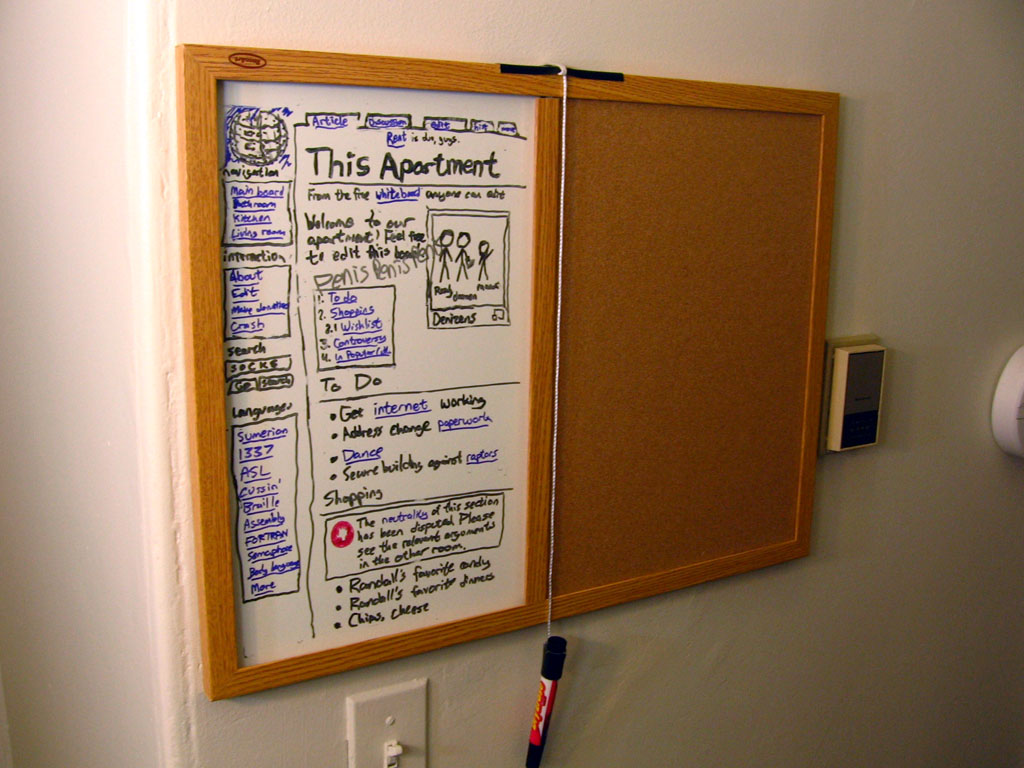
The xkcd author surely understands obsession. Consider this image... how long did it take someone (him) to draw that? Any why? On a whiteboard, no less. Sure, it's a great joke, but was the time spent worth the laughs? To him it was.
Some of you may know that webcomics got me more involved in Wikipedia than just a drive by fixer-upper... reading webcomics used to be one of my obsessions. LEGO still is. But over time, it seems that obsessions change and shift. What drives obsessions? What causes them to change? These are good questions. And important ones to many hobbies...
Wikipedia would not survive without a core of people who were not at least slightly obsessed with it. The same is true of many other hobbies... the NMRA relies on a core of folk who give their time and energy to an organization that ultimately, is all about something not essential to survival. But ultimately, that's a tribute to the success of our civilization. Instead of being obsessed with gathering food and staying alive, that can take up only part of our time and attention, allowing most of it to focus on what really interests us.
What are your obsessions?
Monday, March 10, 2008
Town planning and modular buildings
There's a neat (relatively) new fan magazine on the LEGO scene, called RailBricks. As with many fan magazines, output is irregular, with two issues so far. For some reason, the driving force behind it, Jeramy Spurgeon (that's not a typo) also a driving force of IndyLUG, has listed me as on the editorial board. Maybe because I bought him a beer once? Maybe because I DIDN'T buy him a beer one time and he's getting me back.
Anyway, the next issue has a theme, as did the last one. This one is "tips and tricks" and I've managed to let myself get roped into (possibly... see my post on procrastination!) writing an article for it, on town planning and modular buildings.
Being lazy, I thought maybe I'd rattle on about the topic here and see if I can later reuse some of what I say. Being a procrastinator, I'm writing this blog post now, instead of the real work I SHOULD be doing instead.... OK enough preface! :)
Frank Ellison, a very noted model railroader from its early days, said famously that a train layout is a stage and the trains are the actors. And you can see that's very true for most conventional model railroaders... when you see a layout, it's a series of scenes through which the trains run.
But I'm not sure that's as true for LEGO layouts. At least it seems to me that a certain number of clubs lately have had layouts where the buildings take center stage. I think you'd agree that a layout that features most of the major buildings of downtown Columbus, for example, or a layout with an 11 foot high building and several other very tall ones as well, is not a layout that's primarily about the trains.
Well that's OK, really, as long as you're having fun. But if you want the layout to be a crowd pleaser (and that's what generates repeat income for your club, the buzz a good layout generates with the show organizers, see my previous post on show mechanics) it helps to have some plan and to have your layout "hang together".
Layout planning is a very broad topic and I'm not going to go into it here except to note that it is helpful to have flexibility in your buildings. At MichLTC we find that each layout is different, Some are small, some medium sized, and some are large. We use a block based planning system in which the layout is divided into areas (usually blocks, for city areas) and each block assigned to a builder. (this works for us because the club owns enough road plates to pave all the streets on a typical layout... remember that "generating income bit"?)
Some builders enjoy building large set-piece blocks but I myself prefer to have a collection of buildings to draw from and to pick and choose which buildings I will use with which others.
I can do this because my buildings (and those of my building partner :) ) are modular, they all take up either a half or a full baseplate. Now, in real life, irregularly sized lots mean that real buildings tend to be irregular widths, but for the most part that hasn't been a major drawback for us, the use of full and half width buildings, mixed up, gives enough irregularity.
So I would advocate modularity to allow rearrangement.
But I'll go further. Height matters too. If you look at real city blocks there is a tendency for heights to be somewhat clustered... it is rare (but not unheard of, true) for a 1 story building to be in the same block as a 50 story building. This is a matter of economics, buildings go upwards when there is economic reason for them to do so (high land prices, desire to be near other workers/companies/services). So... if a block is in with other "tall blocks" it is helpful to have tall buildings. And if it's in with other "small blocks" it is helpful to have small buildings.
This argues for vertical modularity as well... the ability to add and remove stories is a useful attribute. it also means that a building can be "finished" and yet you still can add more to it.
So how do you achieve this? That's the subject for my next blog post on this topic area... Stay tuned.
Wednesday, March 5, 2008
On the mechanics and economics of doing shows
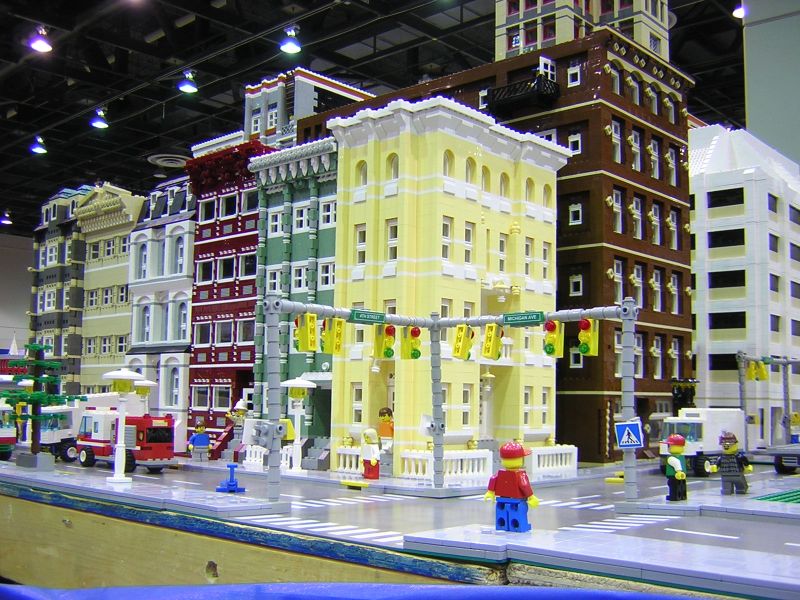
I'm a member of a local LEGO club, Michigan LEGO Users Group (or MichLUG, read more at Brickwiki). Aside from the cameraderie and sharing of techniques and resources, the club exists in part to do public shows. We do several a year (the image at left is from last year's NMRA National Train Show at Cobo Hall in Detroit, which was a multi club show organized by ILTCO, for more views, see this gallery on Brickshelf)
Doing shows is personally quite rewarding for me and I imagine for many other members. Part of the magic is how the display comes together using many different people's work. (I write more about this on my talk page at Brickwiki) In fact you could say that some members are in the club primarily for the fun of doing shows.
So then why wouldn't a club want to do a particular show? The club's mission clearly highlights doing shows as a key activity. We get a lot of requests for shows beyond those we actually do
There are several reasons:
- Schedule - We're all adults with busy lives. We have other stuff going on, and weekend time is precious. We need lead time to plan around things. A show is a big commitment, it usually chews up an entire weekend's free time. The weekends around the holidays are particularly precious. (this seems to be when many show organizers WANT shows, because of the association between toys, trains, LEGO, and the Christmas season)
- Lead time - It takes effort to organise the layout. Every one is different (the NMRA layout, an outlier in size is at right) because the buildings that are available vary based on who is participating and what they want to show. We ask for 3 months lead time.
- Focus - Some shows just don't have the right focus. I talk about trains and train shows because that's what I am interested in, but MichLUG is a general interest club and when there is a chance to do space related things we jump on it.
- Economics - Shows have a cost. We have a trailer and hauling it places takes significant fuel. There is also the cost of staying overnight, meals, and the like. Some shows we do for free because they are good causes (we participated in the local Festival of Trees for several years) but most shows we look at are run by clubs (to raise money for themselves) or for profit organizations, feature dealers selling things, and clubs showing layouts. The public is drawn in by the club layouts but hopefully buys things from the dealers. The organisers get money from the gate, and from the dealers, and pay the other clubs to show up. Sometimes, as much as we might want to help, it doesn't make economic sense.
Consider a recent show request we turned down, one for a 2 day show in Toledo. We got the request on fairly short notice, and it was for a weekend only 2 weeks after our last show. For me to participate, it would be a 180 mile each way trip. If I wanted to bring more than just a few buildings, it would be a trip in an SUV. That would surely be 100 USD in gas. There would also be an overnight stay to defer. So it didn't make sense for me. Other club members who live in Metro Detroit would perhaps pay less but there would still be some cost. So on balance, the amount offered didn't make economic sense for the members, we might well have just donated what we were going to spend to the club. So we declined.
Still, we manage to do a half dozen or more shows a year. I hope this gives some insight. Comments and feedback welcomed of course.
Disclaimer: These are my words and are not official club positions. I was an officer a while back but am not now.
Tuesday, March 4, 2008
Dilution of Critical Mass
This post combines two of my passions, wikis and the LEGO hobby. But not exactly in a complimentary way. :)
"Everyone knows" that Wikipedia is a huge success, and one of the reasons commonly given is due to the large body of articles there, and the large community of interested editors. But it doesn't always come out that way.
LEGO is a natural topic area for a wiki, or so many believe, as there is a lot of information out there to share. (consider the vast number of topics discussed at LUGNET, and the 7000+ set listings available at Peeron.com) And yet, there isn't one wiki to discuss and share information the wiki way about this rich field.
Instead, there are many. Most, but not all, use MediaWiki software
- Brickwiki, around since 2005 (full disclosure, I'm an admin there)
- Brickipedia which is a Wikia wiki and seems to have been active since January 2006
- Brickiwiki (note the one character name difference from Brickwiki, appears to have been started later, and uses Wetpaint wiki software)
Why so many? If you look at these wikis, you will find coverage gaps, topics that none of them adequately cover, as well as coverage overlaps, topics that have essentially the same material. None of them, apparently, have the critical mass to ensure vibrant growth. Some of these wikis have went days or even weeks between successive edits, not exactly what one would look for in an active wiki.
So wouldn't it make sense to combine forces? From the outside the answer would seem yes. And, it has been suggested. (as early as late 2005, in fact, and perhaps earlier) But nothing has ever come of it.
The answer why presumably can be found within human nature.
- Better is the enemy of Good Enough. There is little or no incentive to change things if what you have works. And each of these wikis does have useful content and does have editors and does have readers. If it ain't broke, don't fix it.
- Actually combining these wikis would be a lot of work. Even the ones that are hosted on MediaWiki would require a lot more than just a dump and reenter, redundancies would need to be sorted, and categories reorganised, and so forth. Just tinkering around the edges is almost as satisfying, and far easier. And we're all too busy for such a large, focused task.
- Big frog, little pond. Without casting aspersions on the founders/leaders of these wikis, who would be "in charge" after the merger? That seems an easy question but it has stood in the way of many larger and more critical mergers in the past.