
Showing posts with label Wikipedia. Show all posts

Thursday, February 19, 2009

Dirty Laundry

Italian street, with laundry hung to dryDirty Laundry, out for all to see... Image via Wikipedia

There is rather a nasty thread on WR right now, about me. I have been holding back because this whole thread is wrong on many levels. The following doesn't exactly put me in a very favorable light as far as interpersonal relationships go. So be it.

When I started editing on WP, my wife and I had been estranged for almost 10 years. We led completely separate lives. I was approached by a female Wikipedian and we had a short relationship. That led to a couple more, none lasting more than a few months. To me, at the time, these were serious, sincere relationships, not casual, and I am still on good terms with these women.

After some time, Josette and I started talking again. She decided to look into Wikipedia and LEGO to see if we might find some common ground, and by mid 2007 we had decided to get back together... it's been bumpy, I've made mistakes, and even backslid a couple of times, but we are trying very hard, we are still working at it, and things are getting better. The other women I had relationships with all understand that I have gone back to my wife and they all respect that. One benefit of this statement is to ensure that women that don't know the situation are now also aware of this.

I had heard vague rumors of stuff being shopped around to ArbCom, but until the last few days, I did not know what this was about, or who the person was that supposedly took offense and later raised a ruckus on WR. She gave me no indication of any problem at the time. Rather, she used phrasing like "mad 4 it" in response to my seeking permission as the conversation progressed.

While it is true that I have always been a flirt, this whole thing bothers me because I have always respected the women on WP and women in general. I am sorry if any woman feels I was out of line in my chatting, but I was always, I thought, careful to repeatedly check for permission, to ask if it was OK, and to always remember that "no means no". Even so, I'm sorry anyway, it should not have happened.

The important takeaways from this are:
  • None of this has any bearing on my carrying out my duties and responsibilities on the various wikis.
  • If you think someone is acting inappropriately and you don't like it, call them on it. Or get a friend to say something. Or just leave. Any of those things are better than engaging in whisper campaigns later.
  • The days of my looking for relationships, of having relationships, are in the past, and have been for quite a while, because I am committed to my relationship with my wife.

Enhanced by Zemanta

Friday, August 1, 2008

Knol and Wikipedia

Wikipedia's Knol PageWikipedia's Knol page
Image by dannysullivan via Flickr
Fair use claimed for commentary
By now, everyone and their brother has blogged about Knol. If you don't know what it is, you've been under a rock, apparently (not that there's anything wrong with that)... follow the link. (which naturally leads to Wikipedia)

Probably half of those blogposts have to do with the relationship between Knol and Wikipedia. Again, go find them if you want to read them.

Some people are saying it's a new gold rush. I have an AdSense account so I decided to see what if anything in the way of gold there is to be had.

I've taken some content from Wikipedia and put it on Knol. The content I took is content I myself authored... I took my DYK articles, at the point of the last edit by me prior to the first edit by someone else, so all content was mine, and Knolised them. (why that edit? Because at that point the content is solely authored by me. That means I can relicense it as I see fit, granting GFDL does not take away the right to license under other terms as well)

The actual formatting leaves a lot to be desired, since they are paste jobs, if I see any signs of traffic I'll improve them. But for the most part at least so far, they are the only Knols on those topics. All their links lead straight to Wikipedia, at least for now.

I am not going to pimp them by linking... if you want to find them you can.

I'm curious as to how this all will play out... will these get any traffic? Will I get improvement suggestions? Will Knol itself complain? Most of these show high correlation to Wikipedia which is not unexpected.

What do you think? Have any of you done this? What will the long term effect be?

Zemanta Pixie

Monday, July 7, 2008

You got me...

Randall Munroe, creator of the webcomic xkcd, ...Randall Munroe
image via Wikimedia Commons
So, today's xkcd consists of a drawing of the Wood article in Wikipedia, but cut away to show only the lede, and the bottom, which is a large "in popular culture" section, with such gems as "In episode 7 of Firefly, "Jaynestown", Jayne is given a wooden rain stick by a villager", among others.

Wikipedia is big enough time that it now gets mocked in cartoons on a regular basis (in xkcd's case, lovingly... I think. :) )

Random questions:

Does anyone not think this is one of the funniest Firefly episodes? :) (it goes without saying that I expect most of my readership (all 3 of you) to have seen all the Firefly episodes)

Does Randall Munroe not actually like "in popular culture" sections? Or, is he annoyed that Wood doesn't have one? :) (It goes without saying that it doesn't have one, actually)

Was I the only xkcd reader to go check if Wood actually had an "In popular culture" section? (It goes without saying that I did go check)

Zemanta Pixie

Sunday, May 18, 2008

Her first GA, can FA be far behind?

Engraving of Ann Eliza Bleecker, a socialite and noted poet of New York, United States during the 18th centuryAnn Eliza Bleecker,
Image via
Wikimedia Commons

Forgive me for being a bit proud!

Background: While I tend to get involved in the meta aspects of Wikimedia Foundation projects (sometimes perhaps too much so) as well as write articles, my wife has instead concentrated on editing.

She has stated that she has no interest in becoming an administrator at any of the wikis she frequents. Can't say as I blame her, although she would be a good administrator, I am sure.

Except for occasionally voting in support or (rarely) opposition of various candidates, she stays out of the internal political discussions and controversies of Wikipedia (and other wikis), editing is all she does.

And when she edits, she's rather good. (I admit bias, mind you) I consider myself lucky to have a wife who enjoys many of the same hobbies I do (she's a skilled LEGO builder as well). She has built up a solid record of contributions.

She focuses on relatively obscure female historical figures, primarily Americans of the 18th and 19th centuries, who have been underserved by Wikipedia articles. It's not as glamorous as writing about major contemporary figures, and not nearly as easy, the sources can be hard to track down. But she writes good stuff! Her articles usually make "Did You Know" after they are created.

Case in point, her first Good Article (GA), which I used in my Britannica comparison, and then nominated for GA a few days ago. Yesterday it got reviewed, put on hold, and then, in a flurry of cooperative editing by her, Giggy (the reviewer), and myself, (all coordinated on IRC) had all the faults Giggy identified corrected in under 2 hours (maybe not a record, but quite rapid time for an article to come off hold) and was promoted. Here's an excerpt from the lede:

Saratoga campaign, Tomhannock is just north of Albany and south of Saratoga, New YorkSaratoga campaign,
Image via
Wikimedia Commons

Ann Eliza Bleecker (1752November 23, 1783) was an American poet and correspondent. Following a New York upbringing, Bleecker married John James Bleecker, a New Rochelle lawyer, in 1769. He encouraged her writings, and helped her publish a periodical containing her works.

The American Revolution saw John join the New York Militia, while Ann fled with their two daughters. She continued to write, and what remained of the family returned to Tomhannock following Burgoyne's surrender. She was saddened and affected by the deaths of numerous family members over the years, and died in 1783.

Bleecker's pastoral poetry is studied by historians to gain perspective of life on the front lines of the revolution, and her novel Maria Kittle, the first known Captivity narrative,[1] set the form for subsequent Indian Capture novels which saw great popularity after her death.

Bleecker was an important, if somewhat obscure figure in the American Revolution, and Wikipedia now has a good article about her, where previously it had none at all, thanks to the efforts of one editor. Wikisource also has a considerable portion of Bleecker's existing writings, mostly again thanks to my wife.

And she had fun doing the work. That's the idea. When Wikipedia fosters this sort of thing, it works, and works well. Reading about the issues and things that need fixing can leave you with the impression of a complete disaster, but that's not the case. Imperfect, yes? but darn good. Remember that, please. And go write something!
Saturday, May 17, 2008

The Wikback, RIP?

A Quieter TimeThings are quieter at
Wikback these days
Image from Flickr
One of my earliest postings was about UninvitedCompany's Wikback which is a forum designed to be a place where folk with an interest in Wikipedia and WMF projects could discuss things. (and one that would be run somewhat differently than Wikipedia Review)

At the time, I opined that there might be some inhibitory effects from some of the actions taken and rules in place, and that sparked 11 comments from various folk. I think that may have been my all time high, or pretty close! (Hi to all 3 of you readers still with me!) Some predicted it would fail, while others defended the idea.

Well, two months have went by since then, and it would appear that the activity levels at the Wikback have died down to very low levels. Apparently, in the past 7 days, there have been just 4 active topics, if this list is to be believed.

Not every forum that is started ends up a success. Sometimes it's just random chance as to whether something clicks. But sometimes it's the rules, the people or whatever. Is that the case here?

Could Wikback still spring to lively life? Or is the current activity level likely to be where things stay indefinitely? Or is it over? What do you think?

Thursday, May 15, 2008

Anatomy of a BLP

The Michigan state seal.Seal of Michigan,
NOT a seal of approval!
Image via Wikimedia Commons
Two days ago, I wrote about the recent Supreme Court case involving the "Defense of Marriage" amendment. I mentioned our Attorney General, Mike Cox. On a whim, I decided to go actually look at the Wikipedia article that my post linked.

What a mess I found!

This article is a textbook definition of an unacceptable Biography of a Living Person (BLP) article. Take a look at this revision. It contains word for word text taken from his biography on the State of Michigan Attorney General site, text which is quite flatteringly written (no doubt lifted from his campaign 2006 site, which although now a bad link, is still linked from the article), and which is copyrighted by the State of Michigan.

To "balance" this it also contains text from an attack site, again lifted in large part without change.

No inline citations, just a lot of text. And the article has a long history of (mostly IP user) edits warring over various aspects of the content. You may want to look at the Wikiscanner results too, they are interesting.

Sorry, you don't write a neutral balanced well sourced article by lifting text from puff and attack sites in about equal measure. That gives undue weight to the wrong things. Two coatracks don't make a good article.

So I stubbed it out. This revision shows what it looks like now. Mike Cox deserves a better article than that, but at least it wasn't the mess it was before.

How many other articles like this one on second rank politicians, midsized company CEOs, B list movie stars and the like are there? Those that say there is no BLP problem miss the point.

What do you think? Any horrors you've seen that really need stubbing?

Thursday, April 24, 2008

Doc quits

The Ostrich Struthio camelus is now farmed, primarily for the low fat meat. The Ostrichs are contained by a 2m high fence with an electrified wire running along the top - perhaps contributing to this bird's contemplation of the fence.An Ostrich, although not one
with its head in the sand. Image
via Wikimedia Commons
Doc Glasgow, one of the leading voices in the effort to improve Wikipedia's handling of Biographies of Living Persons (BLPs) has apparently quit the project. (his goodbye statement, ironically enough, was first posted at Wikipedia Review!)

This is unfortunate. It's tempting to just dismiss this departure as one of many, point to UseMod's GoodBye essay, and say it doesn't matter, the project has thousands of contributors. And in fact that's what I usually do. But Doc's voice was a good one and an important one.

Consider this page on the BLP problem and why it's important, and the outpouring of discussion around it.

Or consider this proposal, for allowing marginally notable biography subjects to "opt out", now marked as rejected, and the discussion around it.

Or consider this proposal, for reversing the default outcome of BLP Article for Deletion (AfD) discussions to delete. It has led to this thread at the BLP page itself, in which SlimVirgin proposes adoption. (the straw poll shows it running at least 65% in favor of adopting it so that's something anyway)

Every one of those is from Doc or had Doc pushing hard for it. And those are just the ones I thought of offhand, there are others. Doc was one of the hardest workers on the BLP mess for quite some time.

Perhaps he just got disheartened at the apparent unwillingness of some in the community to admit that there is a BLP problem and that the current approach isn't handling it. Can't say as I blame him, the level of ostrich in the sand -ism seems quite high there.

If you agree maybe you would consider taking the Responsible Editing pledge? Those undersigned are either:
* already using accounts identifying their real identity (and will not use sock puppets on BLPs)
* OR pledging not to add content concerning living people
* OR intending creating separate accounts, linked to their real identities, for this purpose
I signed it. If you edit Wikipedia, you should consider doing so too.

Monday, April 21, 2008

Britannica free access?

Encyclopædia Britannica International Chinese Edition, of 20 volumes of which the 19th and 20th volume are index, is published by Encyclopedia of China Publishing House.A print Encyclopaedia Britannica
Image via Wikimedia Commons
The Encyclopaedia Britannica recently announced "free" access to some of their content. The basic scheme is that if you are one of the "people who publish with some regularity on the Internet, be they bloggers, Webmasters, or writers," you can register for the ability to share access. Their reason?

"Britannica covers a wide range of topics with thousands of articles and multimedia features. They’re relevant and useful, and we’d like more people to be able to take advantage of them." (quoted for review purposes)

Many have said the real reason is more obviously commercial... that Wikipedia is eating into their online market share (and the web in general eating into print encylopedia share, c.f. the recent announcement by a German print encyclopedia that they were publishing their last edition) and that this was an attempt to win market and mind share (as well as Google ranking because there would be more inbound links to their content) TechCrunch observed something somewhat similar.

What's on offer are widgets as well as direct links.

I decided to sign up and see for myself. The sign up process was simple enough, fill out a form, give a link to your blog, and wait. Shortly thereafter I received a mail with another link, I filled that out and now I have access to content. Here's an example widget:


(I haven't sussed out how exactly to specify what I want to display so gosh knows what topic you're seeing.... the help page wants me to watch a video... I'd rather just read directions) and here's an example link (to the Britannia article on Wikipedia).

I think it's instructive to compare that article (go read it, I'll wait) with the Wikipedia article on Britannica... (again, go read it, I'll wait)

While it is true that Britannica has been around longer... and therefore there is more to say, I find it odd how much of the Britannica article seems to focus on Wikipedia's flaws. While I do not fool myself that Wikipedia is perfect, and I have criticised the project for its flaws, it's not quite as dire as EB seems to paint matters. Perhaps they have fallen into the trap of not exactly having a neutral point of view about their competition?

I'll no doubt have more to say about this later but it's an intereesting development. What do you think? Why did EB do this? Will it be useful to folk? Will this experiment work for EB?


Sunday, April 20, 2008

House Flags

Merritt-Chapman & Scott corporate ad, 1938The trigger: MC&S ad
Image via Wikipedia
(fair use to illustrate blog)
In one of those chains of odd connections, it turns out I want to write an article about "house flags"... these are the flags that civil shipping companies fly on their ships to show what line the ship belongs to. The same scheme is often used to decorate the smokestack(s) on more modern ships, which can be seen from farther away

Why do I want to write that article? Well you can thank Rettetast, I guess. He, or his bot, left me a message that a magazine ad image I uploaded (conforming to the then current Fair Use standards) long long ago (mid May 2006, and 2 years is a long time in wiki time) to illustrate the Merritt-Chapman & Scott article was no longer in compliance with current practice, and I needed to write a better justification. Perfectly legitimate and an important thing to fix, since the WMF has mandated all wikis be in compliance with fair use.

In reviewing the article I thought to myself it would be nice, since the MC&S house flag featured in the logo (and in the bottom of the ad) if I could find a house flag image to use that was better than the very grainy one in the ad. So I searched, only to find this page. It has a better house flag all right, drawn by Eugene Ipavec... but the irony of it alll! It's a recreation, based on the very Wikipedia article and image I myself uploaded!

This spurred me to search, and I found that the term "house flag" is used over 30 times in articles but has no article of its own. Doing the research is problematic though, as the term is very common and thus you get a lot of false returns. But I thing I may have found some few tidbits and if i can tear myself away from drama I will take a crack at changing the redirect I put in to become a real article. It may not end up very large but it would be better than the tidbit in the Maritime flags article (which itself is better than nothing)

What serendipitous connections, or even self referential ones, have you found that spurred you? And do you have any leads for good sources for a House flag article? (grin)

Saturday, April 19, 2008

Getting off Hivemind

If you're on Hivemind (the site, not the Hivemind OS software) and you want to get off, all you have to do is publish your real name on your Wikipedia page... simple right?

Except my real name's been there all along. Very first edit to the page, in fact.

But I got added to Hivemind recently. No. I'm not giving you the link to Hivemind, it gets enough inbound links as it is. Trying to ask Brandt why gets zero reply.

Maybe it's more like you have to also not annoy Daniel Brandt by calling him a weenie (or worse, see this blog post). Or maybe you have to get behind whatever his latest hobby horse is... delete whatever he is hot about, sign whatever petition he is keen on, etc. Or maybe ??? Who knows?

Point is, if you want to be seen as acting on principle, as Brandt claims to be doing, you have to actually act on principle, and not act based on personal grudges.

That's what I try to stick to, and "acting on principle" is precisely what I was arguing in defending the redirect deletions... the principle of deleting them was correct even if Daniel Brandt himself was not a nice person.

Else, if you consistently don't act on principle, you're just a bully. As Moulton pointed out, Brandt's actions fit the description.

Kato justified Brandt's tactics here. I suspect that there is some validity to the claim that you have to fight unfairly if you have been treated unfairly. But on the other hand, is attacking those who most want to help the most reasonable way to effect change?

I don't think so. Do you?

Thursday, April 17, 2008

Money can't buy happiness?

Sometimes following tangents finds you interesting things. Danny's "White Fathers" blog post yesterday on what really would help folk in Africa, whether the WMF's mission of knowledge sharing was the most needful thing started the wheels turning for me.

Those wheels got a push from this thread on Wikipedia Review, and from Danny's "Congo" response to it here. I think maybe sometimes we lose track, in our situations, of how things really are and aren't, and what we can do about them. What I'm about to say should in no way be taken as diminishing how tough things are in places like the sub Sahara, the Congo, Sudan, Zimbabwe and the like. They're tough, make no mistake, way tougher than in the rich world...

So when I hear people saying "Money can't buy happiness?" I want to call BS. First, take a look at this classic essay by John Scalzi, "Being Poor" It's a rich world essay to be sure, but it drives home the point... being poor really really sucks.

Then take a look at this New York Times article... Maybe Money Does Buy Happiness After All ... Granted, its a study of the rich world, and of the well off people within it, but (quoting)

The fact remains that economic growth doesn’t just make countries richer in superficially materialistic ways.

Economic growth can also pay for investments in scientific research that lead to longer, healthier lives. It can allow trips to see relatives not seen in years or places never visited. When you’re richer, you can decide to work less — and spend more time with your friends.

That's rich world stuff... but the same thing is true in the less rich world. As Ben Yates cited in a "White Fathers" reply, cellphones can make a difference, and that says to me that aid isn't the solution. Changing society is the solution. Economic growth is the solution. Knowledge is the solution. Danny's right when he says an encyclopedia per se isn't the answer, that more thought is required, it has to deliver the things that are needed. But those who decry encyclopedias and economic and societal change in favour of direct aid? They miss the mark.

Money can't buy happiness? Tell it the the lady in Alabama with the 800 dollar car. Tell it to the mother in Gambia without the money to buy a sack of maize.

Money CAN buy happiness.... but the best kind of money is money you control because you earned it, because your society enabled it, not money that dropped in your lap.

Tuesday, April 15, 2008

More on the BLP policy

Cover of Gissurarson’s biography of Prime Minister Jón Þorláksson (1992)A biography, although
not of a living person :)
Image via Wikimedia Commons
Yes, this is the 4th time I've written about the topic of Biographies of Living Persons (or BLP for short) , and unfortunately, I expect it won't be the last. (here are screeds one, two, and three)

Wikipedia user Doc Glasgow has written an excellent summation of the problem on a user subpage The_BLP_problem. It also includes analysis of several of the possible solutions that have been offered in various places lately. Those who say there is no problem really really need to read this page, it's very well done.

Wikipedia Review folk thought so highly of it that they reproduced it, verbatim (as of when it was copied) as one of their editorials. This topic is now getting more and more attention so I'm hopeful that some progress will be made. As I've said before, the stakes are too high, and the injuries possible to those affected by BLP too risky, not to do something.

To see the magnitude of the problem, take a look at the Some Statistics section in the WR editorial (reproduced from somewhere else I can't find at the moment):

Maintenance category Articles Percent
Total BLP articles
(Category:Living people)
259210 100.00%
Cat:Articles lacking sources 13908 5.37%
Cat:Articles with unsourced statements 13740 5.30%
Cat:Articles needing additional references 5475 2.11%
Cat:Orphaned articles 3157 1.22%
Cat:Articles to be expanded 2511 0.97%
Cat:Articles with topics of unclear notability 1971 0.76%
Cat:Articles lacking reliable references 1918 0.74%
Cat:Articles with trivia sections 1510 0.58%
Cat:Wikipedia articles needing style editing 1420 0.55%
Cat:Articles lacking in-text citations 860 0.33%

Data from March 12 2008

5% lacking sources, 5% unsourced statements, 2% needing references (some overlap there to be sure)... that doesn't even track the articles that are coatracks or hatchet jobs. 5% isn't bad, you say??? except that is 13 THOUSAND articles that may well have problems.

There have been a fair few proposals to address this recently... semi-protection, BLP-Lock, (by SirFozzie, et al) Opt Out (by PrivateMusings, et al) AfD rejiggering (by Doc Glasgow) , dead tree standard, (by many folk) and some I've forgotten.

Some ideas are more radical than others of course... perhaps one of the more interesting offers related to this was Daniel Brandt wagering Hivemind. Probably nothing will come of it. (I made Hivemind myself recently, but that's probably the topic for another posting)

So what do you think? Has the tide turned and we are going to see change in this area at last? Or do you think there's no problem at all?

Wednesday, April 9, 2008

Blog till you drop?

wikipedia pencilsI've got to get me some of these pencils!
Image by kaurjmeb via Flickr
I know that people make money from blogging. (not me, unless you count the 34 cents in AdSense revenue (or whatever it is, I try not to look) I've gotten so far) But I had no idea that there were "blogger sweatshops"...

The New York Times reports that people are burning out, and other outlets are also talking about how some blogges have actually died.

That seems messed up to me. While I've gotten some comments about my update frequency and about the quality of my posts... I'm doing this blogging thing for me, not for pay. As soon as it's not fun any more, I will stop. That's as it should be I would think.

Does this frenzy to work, to make money at blogging have anything to do with WMF projects or with free content in general? Well, I'm not sure. Money? not so much... people shouldn't be creating content for the money... but obsession? I've talked about obsession before and how it ties into doing what we like to do. I am sure I'm not the only Wikipedia editor who has looked at the time in shock, wondering how it got so late! It is easy to lose track during a good work session on an article, a policy page, or what have you, but it's important to keep a sense of perspective. As with anything else, some rotation is good as well... don't JUST hang out at Requests for Adminship, or the Articles for Deletion pages or Featured Article Candidates or whatever... take some breaks.

That's one of the reasons I'm glad I have multiple hats to wear within Wikimedia Foundation projects... when I tired of the hurly burly of the English Wikipedia, there are always pictures to categorise or upload (after all, I've got plenty of old pictures!) over at Commons, or things to do at Meta, or the like. But I also have my other obsessions too. Oh, and a real life and a job and a family and bills to pay. That sharpens the perspective I think.

How about you? How do you keep a sense of perspective?

Monday, April 7, 2008

Information wants to be free

Some Pantone Universe products. Pantone Universe is a brand of everyday items featured in Pantone colors.Pantone colored products,
Image from Commons

So what is the nature of a copyright? What can be protected and what cannot? Consider Pantone... The Pantone Matching System is a proprietary color space used for specifying pigments and colors precisely. Pantone holds that the numbers given to particular shades are "intellectual property" and cannot be reproduced without permission.

So if you want to discuss colors using the Pantone scheme, you have to comply with the requirements. There are many examples elsewhere.

Consider chemical compounds. The nomenclature is very confusing, since there is such a great profusion of them, discovered by many many researchers over several centuries in many countries. Not having a standard will impede progress. The Chemical Abstracts Service, part of the ACS, provides standardized compound identification and nomenclature. But the ACS doesn't want Wikipedia using CAS Registry Numbers for licensing reasons as discussed here. The basic argument is that

"SciFinder and STN are provided to researchers under formal license agreements, under which the researchers agree to refrain from using these tools to build databases"

and that Wikipedia is a kind of database.
Chemical Abstracts Service headquarters in Columbus. Self made photo.CAS Headquarters,
Image from Commons

But, and this is a bigger problem here than it is with colors, these numbers are very standard. You'll find them in many contexts in academia and industry and you can't practically escape their use. Since chemical compounds are a sometime matter of life and death (few people have died from getting slightly the wrong shade of pink, but many have died from getting the wrong drug) standardization theoretically is a good thing to avoid confusion.

Wikipedia has a giant disclaimer that it's not to be relied upon, use at your own risk, etc... but people do rely on it anyway. So not being able to use these numbers will be a great hindrance

But there's hope, in this particular case, the ACS appears to be relenting. See the discussion at the WikiProject for Chemistry ... (as well as in the blogosphere) It now appears that the ACS has reversed position and will work with the project to enable accurate use of information.

Maybe it all will work out in the end. But I wonder if there are general principles to be had here. Is it possible to work with organizations that have proprietary, but vital, information and get to a good outcome in most cases? Have you seen this in other fields?

Sunday, April 6, 2008

More on Anonymity

John Seigenthaler Sr. has described Wikipedia as John Siegenthaler Sr. an early
victim of bad biographical data.
Image from Wikimedia Commons
Recall that I've spoken about anonymity before ... I've also talked about biographies and notability, twice before.

I made a rather loud statement of no longer being in favor of anonymity at the Biographies of Living Persons policy discussion page, as part of discussion on a proposal to limit editing on all such articles using semi protection. This was one of a number of ideas that have been advanced recently to try to deal with the perceived growing problem in this area.

Kim Bruning asked why I felt that a fundamental principle ("anyone can edit") should perhaps change to one in which only those willing to reveal their real name (verified as well as Amazon verifies real names, that is, not a perfect scheme, but not trivial to fake) would be allowed to edit at all. Clearly it goes against the early spirit. And I'm not happy about the idea, to be sure.

Simply put, the reason is that Wikipedia, and the Wikimedia Foundation have become too big. As the projects become more and more important, higher and higher ranked, more and more turned to, the stakes for accuracy are higher than ever before, with no end to this growth in significance in sight. The project participants, and the projects, have a greater responsibility than when this was a toy site.

Merely wishing to do no harm is insufficient. Merely saying that section 230 provides protection because the projects are "not publishers" is insufficient.

Sooner or later, someone with a biography that is seriously damaging (and make no mistake, with 250,000 odd biographies out there, there are sure to be some that are) will be mad enough and well off enough to sue. Don Murphy certainly threatens to. And moreover, with the recent success at securing large donations (a very good thing, make no mistake) the WMF is now a more attractive target.

So what's to be done? More than is being done, I say.

Just as with trademark law, where the holder must show reasonable care in defending against infringment, just as with trespass law, where the owner of a property hosting an "attractive nuisance" must show reasonable care in preventing entry, the projects must show reasonable care at preventing malicious editing of biographies. Tightening of the BLP policy, making OTRS more effective, hiring paid staff, whatever it takes.

But more importantly, the model of anonymous editing, or pseudonymous editing, means that the lawsuit cannot be laid off onto the individual editor that did the bad edit, despite statements that under GFDL the individual contributors are responsible. Server logs and IP addresses are insufficient ties of responsibility. Too easily evaded, too easily used for other things, so deliberately not retained indefinitely anyway.

So... it pains me to say it, but I think the only answer is real names. Real names allow the reasonable care defense, and allow transfer of liability. That has two positive effects, one that it protects the foundation, somewhat, but a bigger positive effect? It makes people actually take responsibility for what they write.

What do you think? Is the project too big for anonymity? Or is there another way out?

Saturday, April 5, 2008

Planet Wikimedia

So I just put in a request to be added to Planet Wikimedia. This feed aggregation collects blogs from various wikimedians and is designed either for blogs that are primarily about Wikimedia Foundation related projects, or else that use filtered feeds to restrict the topics.

I had been holding off for a few reasons...

  1. I wasn't sure I would be able to stick with this for very long, but I've been hitting an average of one post a day for over a month now (with a little fudging, note I said an average!)
  2. I wasn't sure what I would be doing, I thought I'd be talking more LEGO and less WMF, but that hasn't been the case. (I have a few things I want to say about LEGO and I will )
  3. I wasn't sure how to do filtered feeds. But this help explains it. Hopefully I did it right, we'll see. I filtered on Wikipedia, Wikimedia Foundation, and Commons. I (ha!) left out Wikipedia Review as a filter tag.
    The Ouroboros, a dragon that bites its tail, is a symbol for self-reference.Ouroboros.
    Image from Commons

So what do you think dear (4, is it now?) readers? Worth reading and adding or just vanity on my part?

(By the way, this may be the most self referential post I've done yet!)

(Also by the way, see that "Zemified" logo? That's a nifty little addon for Firefox I found from Zemanta, it will suggest links and pictures for you. The Ouroboros image at right was suggested by it when I put 'self referential' into the text)

Friday, April 4, 2008

Ok, seriously... are you TRYING to make Wikidefender's work easier???

Let me get this straight...

Privatemusings has been having podcasts. He's had Danny Wool, he's had Sue Gardner, Wikimedia Foundation Executive Director, he's had Michael Snow, he's had Featured Article director Raul654. He solicits guests and whoever turns up, turns up. He's not afraid of controversial subjects and the casts (despite his tendency to go on a bit instead of letting his guests talk... hmm... who do I know like that!) have been well received, considered interesting and fun.

Number 6 features some folk not known for their high regard for Wikipedia as it stands.

The podcasts themselves are hosted on Commons.

So NonvocalScream decides that to put the page describing podcast number 6 up for deletion at Miscellany for Deletion. Rationale? "banned users are not permitted to edit" as given here. The fact that the files themselves are hosted on commons, and that this is one of a series, seems lost on some... but aside from a few folk, this is almost a snowball keep. It's got the usual folk saying the usual things but it strikes me as a huge waste of time, sorry...

For those that don't get the title reference, Wikidefender runs a blog that many consider to be a bit of a pastiche of the stuff trotted out by those who think everything with Wikipedia is perfect, and may or may not have been the person behind this funny edit to my talk page. Not that he singled me out, NewYorkBrad got one too...

Is it just me or is this sort of nomination actually playing into the hands of those that say that some editors can't help but do silly things?

Thursday, April 3, 2008

xkcd and obsession

Last panel of the xkcd webcomic Sample xkcd comic.
Image from Commons
OK, so xkcd is a webcomic. If you don't know what that means, follow the links.

Anyway, the author of xkcd understands Wikipedia. Consider this comic. (Is there anyone reading this blog who hasn't seen it yet? Oh please! Cap yourself immediately) Consider this reference to xkcd from Wikipedia's Administrator's Noticeboard/Incidents... clearly Wikipedia administrators understand where he's coming from too.

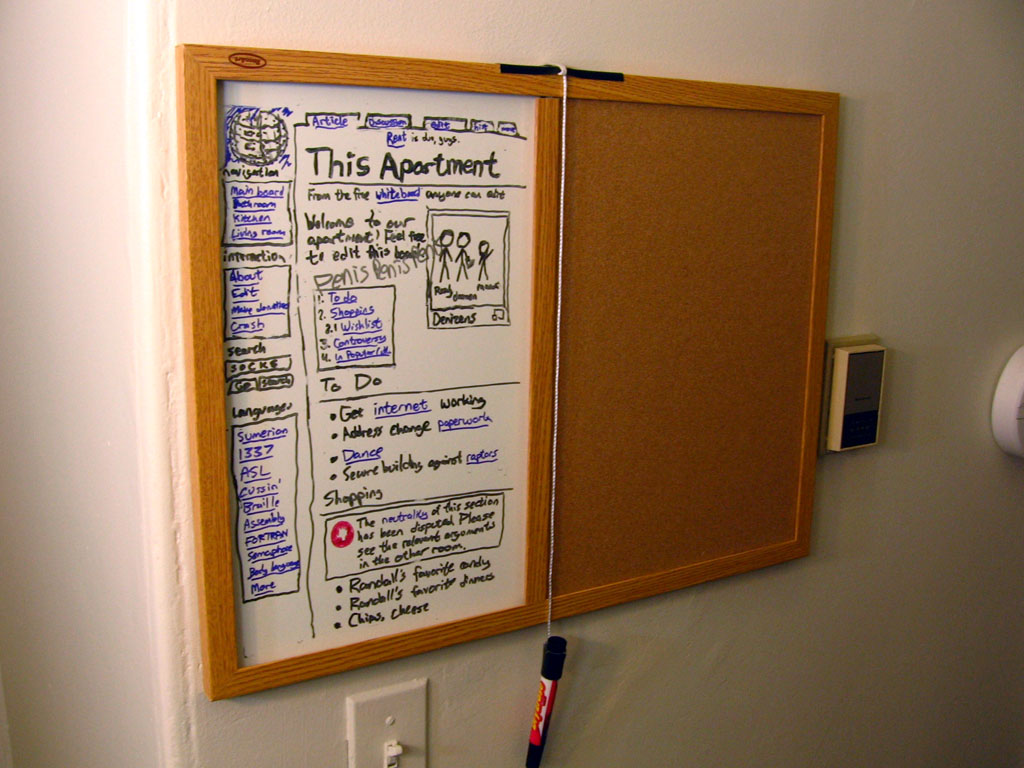
The xkcd author surely understands obsession. Consider this image... how long did it take someone (him) to draw that? Any why? On a whiteboard, no less. Sure, it's a great joke, but was the time spent worth the laughs? To him it was.

Some of you may know that webcomics got me more involved in Wikipedia than just a drive by fixer-upper... reading webcomics used to be one of my obsessions. LEGO still is. But over time, it seems that obsessions change and shift. What drives obsessions? What causes them to change? These are good questions. And important ones to many hobbies...

Wikipedia would not survive without a core of people who were not at least slightly obsessed with it. The same is true of many other hobbies... the NMRA relies on a core of folk who give their time and energy to an organization that ultimately, is all about something not essential to survival. But ultimately, that's a tribute to the success of our civilization. Instead of being obsessed with gathering food and staying alive, that can take up only part of our time and attention, allowing most of it to focus on what really interests us.

What are your obsessions?

Tuesday, April 1, 2008

Happy April Fool's day

Ima Hogg, circa 1910Ima Hogg ca. 1910
Image from Wikimedia Commons
It's becoming a yearly tradition at Wikipedia to have an, ahem, special main page on the first... and this year is no different. (some of the content is dynamic, here are start of day and end of day versions) This page, more or less, is the page from 2007, and this page, more or less, is the page from 2006.

The joke within a joke is... everything on the main page is true. It just doesn't SEEM that way. when you read it A dedicated cadre of volunteers (with too much time on their hands) works at this for quite some time in advance... bringing an article to Featured Article status through the normal process, identifying appropriate "on this day" entries, selecting a special Featured Picture, and so forth. The rules for DYK are bent a bit so that articles older than 5 days are eligible but otherwise, they have to comply with the expansion, referencing, and other requirements.

This years' Featured Article, Ima Hogg ( with the lead of the summary reading "Ima Hogg was an enterprising circus emcee who brought culture and class to Houston, Texas. A storied ostrich jockey, she once rode to Hawaii to visit the Queen." and yes, that really was her name) was brought from nothing to FA status in extremely short order, and yet, it meets all the normal standards.

You can read more about the process at some of the discussion archives: 2006, 2007, and this years. It wasn't always this way. In early years the main page would be subject to what can only be called vandalism (adding complete nonsense, like, oh, that Wikipedia might carry ads, or was bought by Google, or that Google was launching a competitor to Wikipedia, among other things mooted) by established editors, followed by bouts of edit warring as various factions tried to restore normalcy, or restore Foolishness.

With the advent of the enforcement of policy that even on 1 April, everything has to be true, and everything has to work as a normal page (no messing with the links to helps or the page layout or the sidebar) relative peace has come... although some editors still don't even like the use of silly articles, it's hard to argue against a process that remains true to the spirit of truth (although perhaps NPOV is bent a little in writing the gag tag lines).

Do you know of other organizations that do only the truth in their prankery? Google, for example, does not. It has shared such novel new innovations as pigeon ranking, moon bases and this years gem, Virgle Pioneers, with us. (the sad thing is that except for pigeon ranking, these are all things I wish were true.)

What do you think?

(edits: fixed links to 2008 pages. Also note that this tradition is now a big enough deal that it gets media attention, such as this article. )

Monday, March 31, 2008

Attacking the noise...

A Screenshot of Xchat, an IRC client.Xchat IRC client
Image from Wikimedia Commons
...in signal to noise ratio.

I forgot about this, and I'm glad I remembered. It seems that there are IRC channels where fans of xkcd hang out and chat. ( xkcd is a webcomic. If you don't know what that means, follow the links.) Oddly enough, (or maybe not, see my post about obsession) this is popular enough that the channels were suffering from a surfeit of inane comments. Channel regulars were apparently not amused.

Turns out my fellow LEGO fan Dan Boger, alias zigdon (I have no idea why) a wizard Perl coder, and creator of the boffo Peeron.com LEGO set database coded up a bot... what sort of a bot, you say? Well, go read the source code and figure it out!

OK done? Figured it out? Your perl-foo is strong.

Everyone else: It's a bot to enforce originality. Say something in the channel that has been said before, and you get devoiced for 4 seconds. Say another something that has been said before, and the devoice quadruples. Not just something that YOU said before, something that ANYONE said before.
)
Read more about how this came to pass, and then laugh with me. Note, others have blogged about this as well...

I actually got to try this out, and it's surprisingly difficult to not get zapped by the bot. Think you can do better (warning, theoretically, it gets harder as time goes by, all the obvious things to say have been used up)? Try it and see, assuming you have an IRC nickname set up.

Wikimedia IRC channels need this! Well, some of them do. Maybe not all of them :) I suspect that the stewards channel needs people to be able to say !steward more than just the one time. But #wikipedia REALLY needs this! You know it does.