


There's a neat (relatively) new fan magazine on the LEGO scene, called RailBricks. As with many fan magazines, output is irregular, with two issues so far. For some reason, the driving force behind it, Jeramy Spurgeon (that's not a typo) also a driving force of IndyLUG, has listed me as on the editorial board. Maybe because I bought him a beer once? Maybe because I DIDN'T buy him a beer one time and he's getting me back.
Anyway, the next issue has a theme, as did the last one. This one is "tips and tricks" and I've managed to let myself get roped into (possibly... see my post on procrastination!) writing an article for it, on town planning and modular buildings.
Being lazy, I thought maybe I'd rattle on about the topic here and see if I can later reuse some of what I say. Being a procrastinator, I'm writing this blog post now, instead of the real work I SHOULD be doing instead.... OK enough preface! :)
Frank Ellison, a very noted model railroader from its early days, said famously that a train layout is a stage and the trains are the actors. And you can see that's very true for most conventional model railroaders... when you see a layout, it's a series of scenes through which the trains run.
But I'm not sure that's as true for LEGO layouts. At least it seems to me that a certain number of clubs lately have had layouts where the buildings take center stage. I think you'd agree that a layout that features most of the major buildings of downtown Columbus, for example, or a layout with an 11 foot high building and several other very tall ones as well, is not a layout that's primarily about the trains.
Well that's OK, really, as long as you're having fun. But if you want the layout to be a crowd pleaser (and that's what generates repeat income for your club, the buzz a good layout generates with the show organizers, see my previous post on show mechanics) it helps to have some plan and to have your layout "hang together".
Layout planning is a very broad topic and I'm not going to go into it here except to note that it is helpful to have flexibility in your buildings. At MichLTC we find that each layout is different, Some are small, some medium sized, and some are large. We use a block based planning system in which the layout is divided into areas (usually blocks, for city areas) and each block assigned to a builder. (this works for us because the club owns enough road plates to pave all the streets on a typical layout... remember that "generating income bit"?)
Some builders enjoy building large set-piece blocks but I myself prefer to have a collection of buildings to draw from and to pick and choose which buildings I will use with which others.
I can do this because my buildings (and those of my building partner :) ) are modular, they all take up either a half or a full baseplate. Now, in real life, irregularly sized lots mean that real buildings tend to be irregular widths, but for the most part that hasn't been a major drawback for us, the use of full and half width buildings, mixed up, gives enough irregularity.
So I would advocate modularity to allow rearrangement.
But I'll go further. Height matters too. If you look at real city blocks there is a tendency for heights to be somewhat clustered... it is rare (but not unheard of, true) for a 1 story building to be in the same block as a 50 story building. This is a matter of economics, buildings go upwards when there is economic reason for them to do so (high land prices, desire to be near other workers/companies/services). So... if a block is in with other "tall blocks" it is helpful to have tall buildings. And if it's in with other "small blocks" it is helpful to have small buildings.
This argues for vertical modularity as well... the ability to add and remove stories is a useful attribute. it also means that a building can be "finished" and yet you still can add more to it.
So how do you achieve this? That's the subject for my next blog post on this topic area... Stay tuned.
Monday, March 10, 2008
Town planning and modular buildings


Wednesday, March 5, 2008
On the mechanics and economics of doing shows
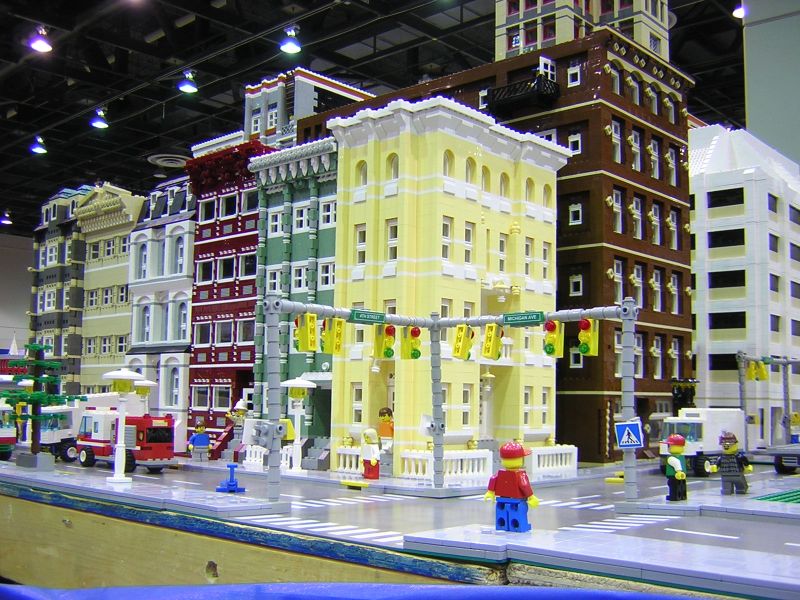 I'm a member of a local LEGO club, Michigan LEGO Users Group (or MichLUG, read more at Brickwiki). Aside from the cameraderie and sharing of techniques and resources, the club exists in part to do public shows. We do several a year (the image at left is from last year's NMRA National Train Show at Cobo Hall in Detroit, which was a multi club show organized by ILTCO, for more views, see this gallery on Brickshelf)
Doing shows is personally quite rewarding for me and I imagine for many other members. Part of the magic is how the display comes together using many different people's work. (I write more about this on my talk page at Brickwiki) In fact you could say that some members are in the club primarily for the fun of doing shows.
So then why wouldn't a club want to do a particular show? The club's mission clearly highlights doing shows as a key activity. We get a lot of requests for shows beyond those we actually do
There are several reasons:
- Schedule - We're all adults with busy lives. We have other stuff going on, and weekend time is precious. We need lead time to plan around things. A show is a big commitment, it usually chews up an entire weekend's free time. The weekends around the holidays are particularly precious. (this seems to be when many show organizers WANT shows, because of the association between toys, trains, LEGO, and the Christmas season)
- Lead time - It takes effort to organise the layout. Every one is different (the NMRA layout, an outlier in size is at right) because the buildings that are available vary based on who is participating and what they want to show. We ask for 3 months lead time.
- Focus - Some shows just don't have the right focus. I talk about trains and train shows because that's what I am interested in, but MichLUG is a general interest club and when there is a chance to do space related things we jump on it.
- Economics - Shows have a cost. We have a trailer and hauling it places takes significant fuel. There is also the cost of staying overnight, meals, and the like. Some shows we do for free because they are good causes (we participated in the local Festival of Trees for several years) but most shows we look at are run by clubs (to raise money for themselves) or for profit organizations, feature dealers selling things, and clubs showing layouts. The public is drawn in by the club layouts but hopefully buys things from the dealers. The organisers get money from the gate, and from the dealers, and pay the other clubs to show up. Sometimes, as much as we might want to help, it doesn't make economic sense.
Consider a recent show request we turned down, one for a 2 day show in Toledo. We got the request on fairly short notice, and it was for a weekend only 2 weeks after our last show. For me to participate, it would be a 180 mile each way trip. If I wanted to bring more than just a few buildings, it would be a trip in an SUV. That would surely be 100 USD in gas. There would also be an overnight stay to defer. So it didn't make sense for me. Other club members who live in Metro Detroit would perhaps pay less but there would still be some cost. So on balance, the amount offered didn't make economic sense for the members, we might well have just donated what we were going to spend to the club. So we declined.
Still, we manage to do a half dozen or more shows a year. I hope this gives some insight. Comments and feedback welcomed of course.
Disclaimer: These are my words and are not official club positions. I was an officer a while back but am not now.